[:de]„Faso Danfani – Kultur, Identität und globale Verantwortung“
Um das Kulturelle Erbe aus Burkina Faso, den traditionellen Webstoff „Faso Danfani“ und
die Zusammenhänge von Globale Verantwortung, Kultureller Identität und Frieden in
Deutschland bekannt zu machen und in der Diaspora zu repräsentieren, soll es mehrere
Veranstaltungen geben. Inhalt sind die inhaltliche Auseinandersetzung mit Mode als Teil
der kulturellen Identität und der Rolle für die Friedensstärkung.
12.09.2026, Ort: Forum Factory
Beginn 17:00 Uhr
1. Filmvorführung des Filmes „Sirene de Faso Fani“ von Michel K. Zongo ( 2014)
Der Dokumentarfilm erzählt aus der Perspektive ehemaliger Arbeiter einer einst
bedeutenden Baumwollfabrik in Burkina Faso. Er zeigt, wie die Schließung der Fabrik im
Jahr 2001 durch globale wirtschaftliche Zwänge Tausende Menschen in Arbeitslosigkeit
und Armut stürzte. Michel K. Zongo beleuchtet die sozialen und wirtschaftlichen Folgen
einer globalisierten Wirtschaft, die nur Wachstum und Zahlen kennt, aber lokale
Bedürfnisse und Traditionen vernachlässigt. Der Film untersucht rund zehn Jahre nach der
Schließung, wie die Betroffenen ihr Leben neu gestalten und welche Herausforderungen
sie weiterhin bewältigen müssen.
2. Panel und Diskussion
Beginn 18.30 Uhr
Referenten: Moderation: Djif Djimeli, Filmemacher aus Kamerun
1. Referent: Ben Isac Compaoré, Modedesigner aus Burkina Faso
2. Referentin: Odile Woni, Sozialwissenschaftlerin aus Burkina Faso
Es gibt mehrere Leitfragen, damit sollen Aspekte aus entwicklungspolitischen,
wirtschaftlichen und kulturellen Bereich abgedeckt werden. Zum Beispiel:
• Welche langfristigen sozialen und wirtschaftlichen Folgen hatte die Schließung der
Baumwollfabrik für die lokale Bevölkerung in Burkina Faso?
• Welche Rolle spielen faire Handelspraktiken und internationale Partnerschaften für
die Stabilität lokaler Industrien?
• Wie kann die Mode- und Textilindustrie in Burkina Faso traditionelle Stoffe nutzen,
um lokale Wirtschaft und Kultur zu stärken?
• Welche Bedeutung haben traditionelle westafrikanische Stofftechniken (z. B. Mali:
Bogolanfini, Indigo, Batik) für die heutige Wirtschaft und Mode?
3. Interaktiver Workshop
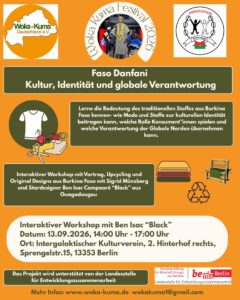
Am Sonntag, den 13.09. von 14:00 bis 18:00 Uhr im Intergalaktische Kulturverein in der Sprengelstr. 15, lädt der Woka-Kuma Deutschland e.V. , 13353 Berlin, zu einem interaktiven Workshop rund um Mode und Fast Fashion ein.
Gemeinsam werfen wir einen kritischen Blick auf die globalen Zusammenhänge der Kleidungsproduktion und beschäftigen uns mit der Frage, welchen Weg unsere Kleidung eigentlich zurücklegt – vom Rohstoff über die Verarbeitung bis hin zum Verkauf. Ein Video und eine Präsentation zum „Weg eines T-Shirts“ geben dabei einen anschaulichen Einstieg in das Thema.
Ein weiterer Schwerpunkt liegt auf traditionellen Stoffen und Handarbeitstechniken aus afrikanischen Ländern. Anhand von Faso Danfani aus Burkina Faso erfahren die Teilnehmenden mehr über die Geschichte, Symbolik und soziale Bedeutung dieses handgewebten Stoffes. Beim Fühlen und Vergleichen verschiedener Materialien wird der Unterschied zwischen traditioneller Handarbeit und industrieller Stoffproduktion unmittelbar erfahrbar. Dabei geht es auch um die Verbindung von kultureller Identität, Handwerk, Tradition und Moderne sowie um die Bedeutung von Handarbeit für gesellschaftlichen Zusammenhalt und Frieden.
Gemeinsam diskutieren wir anschließend die Unterschiede zwischen Fast Fashion und Fair Fashion und gehen der Frage nach, wie Mode nachhaltiger und gerechter gestaltet werden kann. Welche Verantwortung tragen Konsument:innen und welche die Industrie? Welche Perspektiven bringt die afrikanische und westafrikanische Diaspora in diese Debatte ein? Im Austausch werden konkrete Möglichkeiten nachhaltigen Handelns gesammelt – etwa Kleidung zu tauschen, zu reparieren, länger zu nutzen oder bewusster und fair einzukaufen.
Zum Abschluss wird es praktisch: In einem interaktiven Upcycling- und Repair-Workshop können die Teilnehmenden eigene Kleidungsstücke reparieren, verändern und kreativ neu gestalten. Der Workshop richtet sich an interessierte Menschen aus der Nachbarschaft, Modeinteressierte, Designer:innen und Kulturschaffende, Vertreter:innen nachhaltiger Modeinitiativen, Aktivist:innen sowie Menschen aus der afrikanischen/westafrikanischen Diaspora und der Berliner Kunst-, Kultur- und Bildungsarbeit. Im Mittelpunkt stehen Begegnung, Austausch, kreatives Ausprobieren und die gemeinsame Suche nach nachhaltigen Alternativen in der Mode.
Diese Veranstaltungen sind gefördert durch die Landesstelle für Entwicklungszusammenarbeit
 [:en]“Faso Danfani – Culture, Identity, and Global Responsibility”
To raise awareness in Germany about the cultural heritage of Burkina Faso, the traditional woven fabric “Faso Danfani,” and the connections between global responsibility, cultural identity, and peace, and to represent these themes within the diaspora, several events will be held. The program will focus on exploring fashion as part of cultural identity and its role in promoting peace.
September 12, 2026, Location: Forum Factory
Starts at 5:00 p.m.
1. Screening of the film “Sirene de Faso Fani” by Michel K. Zongo (2014)
The documentary tells the story from the perspective of former workers at a once important cotton factory in Burkina Faso. It shows how the factory’s closure in 2001, driven by global economic pressures, plunged thousands of people into unemployment and poverty. Michel K. Zongo sheds light on the social and economic consequences of a globalized economy that focuses solely on growth and numbers but neglects local needs and traditions. About ten years after the closure, the film examines how those affected are rebuilding their lives and what challenges they continue to face.
2. Panel and Discussion
Starts at 6:30 p.m.
Speakers: Moderator: Djif Djimeli, filmmaker from Cameroon
1st Speaker: Ben Isac Compaoré, fashion designer from Burkina Faso
2nd Speaker: Odile Woni, social scientist from Burkina Faso
There are several key questions designed to cover aspects of development policy,
economics, and culture. For example:
• What were the long-term social and economic consequences of the closure of the
cotton mill for the local population in Burkina Faso?
• What role do fair trade practices and international partnerships play in
ensuring the stability of local industries?
• How can the fashion and textile industry in Burkina Faso use traditional fabrics
to strengthen the local economy and culture?
• What significance do traditional West African fabric techniques (e.g., Mali:
bogolanfini, indigo, batik) have for today’s economy and fashion?
3. Interactive Workshop
On Sunday, September 13, from 2:00 p.m. to 6:00 p.m. at the Intergalaktische Kulturverein, Sprengelstr. 15, Woka-Kuma Deutschland e.V., 13353 Berlin, invites you to an interactive workshop on fashion and fast fashion.
Together, we’ll take a critical look at the global interconnections of clothing production and explore the journey our clothes actually take—from raw materials through processing to sale. A video and a presentation on “The Journey of a T-Shirt” will provide a vivid introduction to the topic.
Another focus is on traditional fabrics and handicraft techniques from African countries. Using Faso Danfani from Burkina Faso as an example, participants will learn more about the history, The symbolism and social significance of this handwoven fabric. By touching and comparing different materials, participants can directly experience the difference between traditional handicrafts and industrial fabric production. The activity also explores the connection between cultural identity, craftsmanship, tradition, and modernity, as well as the importance of handicrafts for social cohesion and peace.
Together, we will then discuss the differences between fast fashion and fair fashion and explore how fashion can be made more sustainable and equitable. What responsibilities do consumers bear, and what responsibilities does the industry bear? What perspectives do the African and West African diaspora bring to this debate? Through discussion, we’ll identify concrete ways to act sustainably—such as swapping, repairing, and using clothing for longer, or shopping more consciously and fairly.
Finally, we’ll get hands-on: In an interactive upcycling and repair workshop, participants can repair, alter, and creatively redesign their own garments. The workshop is aimed at interested neighbors, fashion enthusiasts, designers, and cultural professionals; representatives of sustainable fashion initiatives; activists; as well as members of the African/West African diaspora and those involved in Berlin’s art, culture, and education sectors. The focus is on connection, exchange, creative experimentation.
These events are funded by Landesstelle für Entwicklungszusammenarbeit
[:fr]« Faso Danfani – Culture, identité et responsabilité mondiale »
Afin de faire connaître en Allemagne le patrimoine culturel du Burkina Faso, le tissu traditionnel « Faso Danfani », ainsi que les liens entre responsabilité mondiale, identité culturelle et paix, et de les représenter au sein de la diaspora, plusieurs événements sont prévus. Ces événements porteront sur une réflexion de fond autour de la mode en tant que composante de l’identité culturelle et sur son rôle dans le renforcement de la paix.
12 septembre 2026, lieu : Forum Factory
Début à 17 h
1. Projection du film « Sirène de Faso Fani » de Michel K. Zongo (2014)
Ce documentaire raconte l’histoire, du point de vue d’anciens ouvriers, d’une usine de coton autrefois importante au Burkina Faso. Il montre comment la fermeture de l’usine en 2001, due à des contraintes économiques mondiales, a plongé des milliers de personnes dans le chômage et la pauvreté. Michel K. Zongo met en lumière les conséquences sociales et économiques d’une économie mondialisée qui ne connaît que la croissance et les chiffres, mais néglige les besoins et les traditions locales. Près de dix ans après la fermeture, le film examine comment les personnes concernées réorganisent leur vie et quels défis elles doivent encore surmonter.
2. Table ronde et débat
Début à 18 h 30
Intervenants : Modération : Djif Djimeli, cinéaste camerounais
1er intervenant : Ben Isac Compaoré, créateur de mode burkinabé
2e intervenante : Odile Woni, sociologue burkinabé
Plusieurs questions clés seront abordées afin d’examiner différents aspects
Plusieurs questions clés ont été formulées afin d’aborder des aspects liés à la politique de développement,à l’économie et à la culture. Par exemple :
• Quelles ont été les conséquences sociales et économiques à long terme de la fermeture de l’ usine de coton pour la population locale au Burkina Faso ?
• Quel rôle jouent les pratiques de commerce équitable et les partenariats internationaux pour la stabilité des industries locales ?
• Comment l’industrie de la mode et du textile au Burkina Faso peut-elle utiliser les tissus traditionnels pour renforcer l’économie et la culture locales ?
• Quelle est l’importance des techniques traditionnelles de fabrication de tissus ouest-africaines (par exemple au Mali :bogolanfini, indigo, batik) pour l’économie et la mode actuelles ?
3. Atelier interactif
Le dimanche 13 septembre, de 14 h à 18 h, à l’Intergalaktische Kulturverein, Sprengelstr. 15, l’association Woka-Kuma Deutschland e.V., 13353 Berlin, vous invite à un atelier interactif autour de la mode et de la fast fashion.
Ensemble, nous porterons un regard critique sur les enjeux mondiaux de la production vestimentaire et nous nous pencherons sur le parcours réel de nos vêtements – depuis la matière première jusqu’à la vente, en passant par la transformation. Une vidéo et une présentation sur « le parcours d’un t-shirt » offriront une introduction claire et concrète au sujet.
L’accent sera également mis sur les tissus traditionnels et les techniques artisanales issues des pays africains. À travers l’exemple du Faso Danfani du Burkina Faso, les participants en apprendront davantage sur l’histoire, Symbolisme et signification sociale de ce tissu tissé à la main. En touchant et en comparant différentes matières, on perçoit immédiatement la différence entre l’artisanat traditionnel et la production industrielle de tissus. Il s’agit également du lien entre identité culturelle, artisanat, tradition et modernité, ainsi que de l’importance de l’artisanat pour la cohésion sociale et la paix.
Nous discuterons ensuite ensemble des différences entre la « fast fashion » et la « fair fashion » et nous nous pencherons sur la question de savoir comment rendre la mode plus durable et plus équitable. Quelle est la responsabilité des consommatrices et consommateurs, et quelle est celle de l’industrie ? Quelles perspectives la diaspora africaine et ouest-africaine apporte-t-elle à ce débat ? Au cours de cet échange, nous recenserons des moyens concrets d’agir de manière durable – par exemple en échangeant, en réparant ou en prolongeant la durée de vie des vêtements, ou encore en achetant de manière plus consciente et équitable.
Pour finir, place à la pratique : lors d’un atelier interactif d’upcycling et de réparation, les participant·e·s pourront réparer, transformer et réinventer de manière créative leurs propres vêtements. L’atelier s’adresse aux personnes intéressées du quartier, aux passionnés de mode, aux créateurs et créatrices ainsi qu’aux acteurs et actrices du secteur culturel, aux représentants et représentantes d’initiatives de mode durable, aux militant·e·s ainsi qu’aux personnes issues de la diaspora africaine/ouest-africaine et aux acteurs et actrices des milieux artistiques, culturels et éducatifs berlinois. L’accent est mis sur la rencontre, l’échange, l’expérimentation créative.
Ces manifestations sont soutenues par l’Agence régionale pour la coopération au développement – Landesstelle für Entwicklungszusammenarbeit
[:]